Showing posts with label classes. Show all posts

Saturday, 4 January 2014

It was always so hot, and everyone was so polite, and everything was all surface but underneath it was like a bomb waiting to go off.

Today I will attempt to answer the question: What is the South?

From Southern Studies 101 to Southern Studies 601, from Mississippi to North Carolina, I have talked to a lot of people about what "the South" really means. We draw lines between different countries, but defining a region is more complicated.

In the UK, we pretty much understand where England ends and where Scotland and Wales begin. But I've found that people get more argumentative when it comes to placing counties within a region. For instance, when I was at UEA, I heard people argue that Norfolk was part of the North, the South, the Midlands, the East and the Southeast. (Can't we agree on "East Anglia?") Defining, say, the South of England, would be entirely subject to context and individual perspectives. It's exactly the same in the US, except they like to talk about it a lot more.

During my first semester at Ole Miss, someone asked if it was my first time in the US.

"No," I told him, "I lived in North Carolina for a year."

He replied, "Oh, so this is your first time in the South!"

What? Is North Carolina a Yankee state now? My North Carolinian fiance grinds his teeth at the very suggestion he is not a real southerner.

There are some states that most people willingly agree are part of the American South (such as Alabama and Mississippi), and others that are more up for debate (such as Texas or Kentucky). For some people, the Deep South is somehow "more southern" than the culture found in the Carolinas. So who's in, and who's out? Who is at the center and who is on the fringe? How do you define a region, and what does it all mean in the end?

Here are some different definitions of what some consider to be "the South":

Geographical Definition

"The relationship between the Mason and Dixon needs some fixin'." 
- LL Cool J. 

(Who could do with enrolling in Southern Studies 101. Brad Paisley should come too.)

As you can see from the map on the right, the US Census defines the South as encompassing the following states: Maryland, West Virginia, Virginia, Kentucky, Tennessee, North Carolina, South Carolina, Georgia, Florida, Alabama, Mississippi, Arkansas, Louisiana, Oklahoma and Texas.

What a big party! And it really does screw with you when you're trying to use statistics to back up a point about rural culture and big cities such as Dallas and Tallahassee keep getting in the way. Moving on...

Historical Definition

"Advance the flag of Dixie! Hurrah! Hurrah!
In Dixie's land we take our stand, and live or die for Dixie!" 
- Confederate States of America War Song. Also Kevin Spacey, briefly.

The South is still defined today by its role in the 19th century: secession from the Union (on the part of - in order - South Carolina, Mississippi, Florida, Alabama, Georgia, Louisiana, Texas, Virginia, Arkansas, North Carolina, Tennessee), support of slavery, formation of the Confederacy and subsequently the Civil War. To tell the whole truth, despite the fact that I am a Southern Studies student, I am no Civil War buff. Eventually I will sit down and watch the entire Ken Burns TV series.

But for now I will just say that I was honestly surprised by how much the Civil War still has a ghostly presence within the South. Also known as "the war between the states" and "the war of Northern aggression", it did after all end as long ago as 1865. Yet it is referenced far, far more than I can recall World War II being brought up during all my years in Britain, and that was only my grandparents' generation. I can remember being a young girl and hearing soldier stories from my grandfather, evacuee stories from my grandmother - but I never digested it as a source of personal pride or personal history. The Confederacy still is a part of southern "tradition" for some families and individuals, which manifests in a number of ways: joining a group like the Daughters of the Confederacy, celebrating Robert E. Lee Day, flying the Confederate Flag, etc.

 Cultural Definition

 "The old game, I suspect, is beginning to play out in the Bible Belt." - H.L. Mencken. 


It occurs to me that "the South" is not always a recognizable term to those who do not call the United States home. Which leads to a somewhat awkward situation when I try to explain what I'm getting a Master's in. Southern America... You mean like Brazil? No, just no. At least you'll be close to you boyfriend in California, right? Hmm... How near is it to New York/Washington D.C./Chicago/Los Angeles? It's not. I can sort of work with you if you know where Florida is though.


You get the idea.

But what people DO know is that some parts of America are very, very religious. Occasionally someone will ask, "Is Mississippi in the Bible Belt?" Yes, yes, YES. Now we are getting somewhere! The Bible Belt refers to the southeastern (and sometimes southcentral, and occasionally midwestern) states of the US, and points to the proportion of evangelical Protestants, as well as the importance of religious/church culture in general. Sometimes you hear the phrase "the Buckle of the Bible Belt", as in most extreme, but it is apparently a multi-buckling belt as many places have been labeled this, based on the presence mega-churches, percentage of Baptists, or perhaps Pat Robertson appreciation.

My department at the University of Mississippi is called the Center for the Study of Southern Culture. It's exactly what it says on the tin: we study culture. What is culture, aside from religion? In academic gobbledeegook, we are an interdisciplinary bunch who study topics such as literature and literary theory, history, sociology, anthropology, documentary, ethnography, communications, globalization, politics and economics. Each discipline gives us a small idea of southern identity, even as it may obscure other ideas. Culture is not always clear-cut and harmonious. It is complicated, in flux, evading conclusions.

I can give you southern tropes with which to communicate ideas about the South, but as I've said, these are mere dots of the puzzle. Southern people say "y'all." Faulkner, Welty and O'Connor wrote southern literature. Let Us Now Praise Famous Men documents southern life. Charlotte, North Carolina, is the headquarters of Bank of America and is part of the global South. The South is so vast, so varied, so complex, that even after years of study - and for some, a lifetime of experience - there is always more to learn.


 Personal Definition

“I quickly realized there is no such thing as the South; there are just hundreds of souths." - Wiley Cash.

If I had to pin down the main reason why I love to study culture, I would say its fluidity.

Most people know I am far from a black-and-white person. I believe in moral relativism, I am agnostic, I see the world in terms of multiplicity. I am also not an ambivalent person. I find our world contradictory, unjust sometimes, unfathomable and yet meaningful - never boring, never not worth thinking about. I get lost in the details of life, people and places. I know I can never fully answer a question like, "What is the South?" and yet I will try for the rest of my life.

To end this post, I have a challenge for you.

Whether you have lived in the South all your life, moved there for college or a job, married a southerner, taken a trip to Atlanta, watched Gone With The Wind one time, or never heard of it until this post, I want you to take a moment to think about this.

Set a timer for 1-2 minutes. Without stopping, write down everything that comes to mind about the South.

I'll end here with what I came up with, and I hope some of you will share your thoughts too.

The South is...
Sweet tea, long porches, slow talking and soft accents, nice manners, racism, women who want to get married young, excellent universities, storytelling, conflict, sweet potato mash with marshmallows, humidity, buzzing cicadas at night, football and basketball, blue skies, mountains, banjos, MLK, honey, peaches, patriotism, guns and cars, rednecks, cotton and mills, grits, Elvis Presley.


Monday, 12 August 2013

I lost two cities, lovely ones. And, vaster, some realms I owned, two rivers, a continent. I miss them, but it wasn't a disaster.

What did I do THIS time?
I left you with a kind of cliffhanger in my last entry.

You may be wondering what is going on with my patched up feet. Well, I'll get to that. It's part of my story of the first ten days of living in Oxford. I'm writing this in part to remember it and tell a good yarn, but also as a comfort to anyone who has just started out abroad and is having a tough time.

My first few days were exactly as you would expect. I moved into my apartment, bought items at the local Walmart, collected a package of tea and goodies I had sent myself, and attended several orientations. And I do mean several.

The first was a day-long international student orientation, in which I met students from many countries including Canada, China, Ethiopia and Mexico. The orientation leaders went through the alphabet and had people shout out their countries as we got to each letter. There was some confusion about how to represent us. United Kingdom, Britain, Great Britain, England? I grew up thinking of myself as English and being from England, but American vernacular has seeped in and now I refer to myself as British and from the UK. Whatever. We talked about classes, culture, healthcare, food, politics and, rather importantly, immigration matters. This is why I don't get the movie Like Crazy. Did her school not provide her with an orientation? Why would she just overstay her visa like that?! Everybody knows you don't overstay your visa!

I expected better from you, Ethel Hallow.

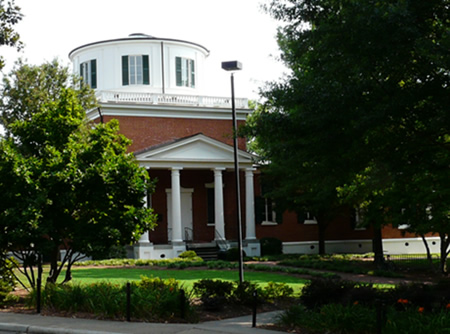
The next day we had a very long Graduate School orientation, which unfortunately covered a lot of the same matters... On the one hand, I applaud US universities for making such an effort to inform students right away. On the other hand, I kind of like the British approach which is to mumble awkwardly for 30 minutes then hand you a bunch of paperwork that you will inevitably stash away and forget about. Anyway, we were let out of the auditorium for the glorious sunshine, plus free lunch and a T-shirt. Here I met a few people from my program, who I would see again the next day at the Southern Studies orientation. We sat in the conference room of Barnard Observatory, where I would have many classes, and shared our interests and where we were from. We were introduced to members of the department, including a few second years. Then we had a picture of the 13 of us outside on the steps of Barnard to mark the occasion. "Dear God," I thought, getting in to the spirit of Mississippi life, "Please let me graduate." Then one last orientation for those of us with assistantships.

I'll talk more about my assistantship and classes in another entry, but for now I'll give you the basic details. In the Fall semester, my assistantship consisted of a Teaching Assistant position for a Southern Studies 101 class, and a Research Assistant position for a professor in the department. In the Spring semester, I continued to be a TA while assisting with research for the Mississippi Encyclopedia. As for classes, in the Fall I took a compulsory Southern Studies graduate seminar, a Southern Foodways class affiliated with the Southern Foodways Alliance, and Documentary Studies. In the Spring, I continued with the graduate seminar, plus a class on Faulkner and an internship with Living Blues magazine. I spent most of my undergraduate years attempting to give all my projects a southern leaning, and now I don't even have to try! It's such a great program and I feel very lucky to be part of it.

My new home, Barnard Observatory.

On top of the orientations, there were several social events organized by the department. As you can imagine, the summer evenings in Mississippi are very nice; once the sun goes down it is less unforgivably stifling and a much more pleasant temperature. So many events are held in the garden/yard. Now, given my disaster with mosquito bites during my first week at Chapel Hill, I came to Oxford with many insect repellant supplies: cream, spray, and even a special type of sunscreen with some mixed in. I say that it my own defense, because every time I am bitten someone scolds me for not putting any bug spray on. I DO use it, it just isn't 100% effective and those damn things seem to just LOVE my blood. Actually, I believe they love pasty white English skin, as other internationals have been bitten badly too. Anyway, can you guess what I'm leading up to? I was bitten all over my feet and legs.

It was worse than the time in Chapel Hill. I repeat, IT WAS WORSE THAN THE TIME IN CHAPEL HILL.

Always the overachiever, when I visited the doctor he pronounced my hivey feet as, "the worst case of insect bites he had ever seen." I was then prescribed antibiotics, a large dose of steroids, and rest. So I sat in my new apartment with my boyfriend, who had now missed his planned departure date in order to wait on me, change my dressings, and carry me from the couch to the bed. Here's another important detail to this story: I was already considering moving out. I can't go into the full details, but suffice to say, there was a safety issue with the apartment that I considered to be a dealbreaker. As I was trying to get my head around moving somewhere else already and thinking of all the legal/logistical things I had to do before the semester got underway, I got much sicker.

There is some debate as to what actually happened, as different doctors suggested the following: a) They were not actually mosquito bites, b) They were mosquito bites, and were also carrying West Nile disease, c) I had an allergic reaction to the antibiotics, steroids, or both, d) I was prescribed too high a dosage of steroids. Personally, I think I am just more allergic to bites than anyone most doctors come across (I get hives and dizziness), and the enormous amount of steroids didn't help. Anyway, I ended up in the emergency room, crying about my new ridiculous life in Mississippi and the fact that no one understood my accent, requesting to see my parents, and having to email my department at 4am to say I would be missing the first day. Not a good omen for the rest of the semester.

In the end, it all turned out okay. I moved out of my apartment and into a house with two North Carolinians (plus a cat and a dog), gathered furniture for my new room, said goodbye to my boyfriend, and hung my ER bracelet up on my bulletin board. I kept it as a reminder that, no matter what happens here, it could not be worse than the first week.

But that was before I had experienced finals week.

I'm kidding. I know how much it sucks to have your very first week in a new place be filled with uncertainty, sadness and sickness. In Chapel Hill, I missed a few of the early social events and felt like I was late to the game with making friends. Being sick for my first weekend brought on an unexpected wave of homesickness. I let that homesickness define me. I let it pull me right down into a depression that took months to get out of. In Oxford, I am proud to say that I did not repeat those mistakes. I did experience homesickness again, and I did have some stressful days that made me cry and wish I'd stayed home. But for the most part, I got on with my life. I reached out to people, made new friends, worked hard for my classes and job, and before I knew it the end of the semester was near and Oxford was my new home.


It's hard to have stability in a new place, especially if you've only got a few months or a year to experience it. I remember that before I left the UK, I was told about the stages of culture shock. Theoretically, I was supposed to looove the new place in the beginning and feel some culture shock a few months in. Maybe this is dependent on personality, as some people don't seem to experience culture shock at all. For me, every time I have moved, whether to Norwich, Chapel Hill, Oxford or home at any time, the first month was the hardest. I guess what I want to say is, no matter where you fall on the spectrum of reactions to moving abroad, remember to reach out to other people. Reach out if you need help, but also if you're doing great and could cheer someone else up. (This applies to those at home as well as abroad.) I'm also happy to help anyone who wants some TLC via email or Skype. Really, no one needs to go through what I did the first time around. This is what I realized in Oxford, and I'm much happier for it.

For anyone who's struggling, remember that those of us with the scary experiences have the best stories to tell! Not convinced? When I got back to UEA, I mostly had classes with others who had returned from a year abroad. Sometimes I would start telling a story to the person next to me, and it was often so outrageous it would make everyone turn around to listen. I can promise you that was not the case before.

So how about y'all? If you've lived abroad before, how was the first week? If you're going abroad soon, what are you excited and/or nervous about?

Thursday, 22 March 2012

"Is he in therapy?" "Nah, he's got me."


I wasn’t planning to write again until next month, when I am once again going to San Francisco followed by the BAAS conference/banquet in Manchester. However, I recently attended a meeting for outgoing year abroad students which inspired me to write this entry. Dr Rachael McLennan asked me to come so that I could talk about my year abroad experiences and how they informed my dissertation and led to my scholarship. As I sat there, it suddenly dawned on me that all the advice being given was still relevant to me, since… I am going abroad this summer too! I know – I should really try to remember that. Anyway, I wanted to write about what I wish I had known whilst I was abroad in case it is useful for anyone else. I also think it will be useful for me.

I had so many intentions before I left for Carolina, but once I got there my motivation dwindled and I mostly stewed in my homesickness and frustration. I don’t want to make the same mistakes again. I’d like to think that it will all just be easier this time and shrug it off, but if I have learnt anything from my year abroad, it’s that self-awareness is your best friend. I can’t know or prepare for everything that’s to come, and I wouldn’t want to anyway. Oxford is the next adventure for me, and my excitement far exceeds my anxiety. Part of taking a big risk like that is accepting that you’re going to be in freefall. Even so, I hope that my previous experiences will be beneficial (to anyone else, too, if you are reading!).

As you will glean from the structure of my points, I don’t believe in hard and fast rules, but about trying to create a healthy balance. Here are some of my best lessons…

Be Proactive and Assertive
I think at UEA we are lucky to have so many open societies which actively look for more members. I found that UNC was more of a puzzle, and I didn’t have much luck joining anything or finding out about events. Despite the early disappointments, I really wish I had kept trying. I wish I had seen more plays, attended more campus events, explored new places – even if I had to go by myself. I was so used to being part of a group at UEA that I never learned just to go and enjoy something on my own. It’s an important skill and it will stop you from missing out. Out of my comfort zone, I also became more reserved. I stood in my own way when it came to making friends and wasn’t assertive enough; consequently it took me a long time to make them. Don’t allow yourself to stop trying if it doesn’t go your way at first. Keep going. Push yourself.

BUT Take Care of Yourself
Sometimes it’s okay to just watch One Tree Hill in your bed (especially if you’re in North Carolina, then it’s practically research). Really. Don’t feel like you have to do everything if you don’t feel like it. I routinely tortured myself about everything I was missing out on, and it was pointless to put so much pressure on myself. When I look back, I realise that I do have a lot of good memories, even if they were just hanging out with my friends and not doing anything “significant”. Not every day is going to be exciting or even pleasant at all, and that’s okay. Being somewhere new is incredibly stimulating, but it’s also overwhelming. I wish I had been easier on myself, and done more to feel good. I would definitely recommend taking advantage of the free gyms, different sports/exercise opportunities etc. I really regret not taking up running in Chapel Hill, since it’s a beautiful area and it would have kept me healthier. (Better late than never, though – and Norwich is beautiful to run around too!) Also, reign yourself in when it comes to the food. I’m not just talking about weight gain (though that was a definite part of my year abroad), but about the fact that there can be a lot of additives etc which your body is not used to, and it can make you unwell. Also, be careful with alcohol. It’s all very well to have a good time, but you’re much more vulnerable in a new place with new people.

Communicate with Others
It’s great meeting new people, but sometimes you will just want to hear a familiar voice. I was a Skype and Facebook addict the entire year, and for the most part I loved hearing what was going on at home. I wanted to stay connected to my life in Norwich. It’s important to have encouragement from the people who know you best. It’s also important to be open with the people around you. Ask your new friends, your professors, etc, to help you out if you are struggling. I was often far too stubborn for my own good, and did not want to admit how much I needed other people to help me, or to make a change in my situation. I could probably have avoided a lot of pain and drama if I had spoken up earlier about what was going on with me, or accepted the olive branches being offered. It’s also really important to talk to people who have been through the same, whether that’s people at your university who have studied abroad, other international students, or friends from home who have done American Studies or similar. (Here I feel I should say a big thank you to Ailsa Bristow!)

BUT Listen to Yourself
I’ve just admitted that I’m stubborn, but conversely I was a victim of listening to other people too much. When I was having trouble at UNC, I found that a lot of people were (unintentionally, I’m sure) dismissive about how hard it was. When you have never lived abroad, it is completely impossible to truly comprehend how isolating and lonely it can be. Some of my isolation was most definitely my own doing, but a lot of it was out of my control. When you are struggling, it only makes it worse to have someone tell you that it’s not a big deal or that you’re just not trying hard enough. What is even worse than that is to believe it yourself. Be honest with yourself, and try hard, but don’t blame yourself if everything isn’t perfect. The other point I want to make here is how important it is to pay attention to your own needs. I think if I had had the courage to make decisions just for myself, and not worried about what other people would say about it, I would have been much happier. Sometimes it is not selfish or arrogant to decide that you know best, it’s just the truth.

Document Your Experiences
Takes photos, keep a journal, keep a blog (hi), make a box of keepsakes. It’s a good idea to carry your camera around with you, even just to take pictures as you walk around campus. I loved writing this blog. It forced me to have a sense of humour even when all I wanted to do was cry and book a flight home. I’ve written a journal most of my life (regularly for 10 years now), and I think it’s an excellent way to appreciate the little things in life, and to hold yourself accountable to mistakes. When I read back on my personal journal, it’s a little painful to see how much I struggled sometimes, but it also tells the most outrageous stories. The most dramatic of those were from my month of travelling around with Jess and Faye. I have many photos from our trip that I cherish and look over every time I need a laugh. Though it may not feel like it at the beginning, the year goes by very fast, and it’s important to preserve the memories as best you can. As was mentioned in the meeting, something like a blog may come in handy later when you’re applying for jobs. The biggest benefit to me was being able to write something that a lot of people were interested in reading – it actually put me back in touch with old school friends who had followed the links on Facebook. I’m intending to be a more regular blogger when I go to Mississippi.

BUT Remember Your Life is Not a Movie
I said already that I was a Facebook addict. I know it is a double-edged sword. Photos, communication, information, humour = good. Stalking, jealousy, wallowing, grammar atrocities = bad. I was so worried about what people thought of me at home, falling from my social/academic grace abroad, that I became obsessed with how I appeared on Facebook. I haven’t changed my profile picture in two months – are people talking about how I must not have any friends? Was that last status funny, or a little too whiny? WHY IS THAT PERSON HAVING SO MUCH MORE FUN THAN ME? Try to remember that Facebook is not a true reflection of reality. Also, whilst I mentioned that photos/journals are important, the best moments I experienced abroad were not photographed, blogged about, or shared on Facebook. University is an incredibly social experience, and I was so bound up in that at UEA. At Carolina, I truly learned to be comfortable by myself. My most vivid memories are of private moments in which I got closer to a friend, finally felt like I could do Zumba, or finished a particularly challenging project. I didn’t need to stop and take a photo in order to remember it.

Congratulate Yourself
This is probably one of the hardest things you will ever do. Well done for considering it, well done for taking the plunge, well done for staying where you are, well done for making the most of it, well done for coming home a better person. Applaud yourself every day!

BUT Say Thank You
I have to admit, I was not always as grateful as I should have been. I was so consumed in my own unhappiness at points that I did not take enough time to say thank you. I hope that by the end of my time I was a lot better at expressing my gratitude to all the wonderful people that supported me. Part of the reason why I chose to write my dissertation on empathy is because I realised just how important it is. It is because of the people that took the time to listen and to understand that I was able to keep going, to make sense of the difficulties, and to trust that things would get better.

And now for the most important tip of all…

For God’s sake, apply insect repellent.

Good luck to everyone going abroad this summer!

There's not a lot of reason to this other than the fact that I love Obama. And he has great facial expressions.
ETA: So I just discovered that you can look up stats to see how many people are reading. I have had far more people stumble across this blog than I expected! I know that some probably got here by mistake or clicked back immediately (especially if all you saw was the pic of my bug bites - sorry!) but if you do read this blog, please leave a comment to let me know! Sometimes people email me or comment on my Facebook but it would be great to get comments here, too, just to know what your thoughts are, if you've had similar experiences, etc. Once I'm back in the States I would really love suggestions for what to write about. :) /end vanity.

Sunday, 31 October 2010

Welcome to “the land of big trucks and expanding guts.” (Cody Jones.)

I'm sorry for the lack of regularity where this blog is concerned. I've never forgotten about it, of course, but as any university student can attest, sometimes your weeks are so busy they positively fly past. It's often like you're trying to write an essay whilst caught up in a tornado. Anyway, a lot has been going on and I have plenty to write about. I visited the mountains in a place called Asheville, went to the North Carolina State Fair in Raleigh, experienced my first UNC football game and today is Halloween.

I also found out that, with my combination of modules, it will never be possible to complete all of my assigned reading. In that spirit of things, I got a D on a midterm and my grades started to slip all round. It's been hard to deal with; at home I was often top of my class and it's hard to cope, self-esteem wise, with struggling so much. The one thing I've realised is that a year out here is completely different to a year at home, in terms of what I'm trying to get out of it. Here, I don't have to like everything I learn, but being exposed to so many new teaching styles is invaluable experience if I ever become a lecturer myself. It's not to say that I'm not getting anything out of the classes here – they're excellent. I just can't give them the focus they need, and the style is so different. I excel at long essays with room for creativity and originality, but short answer questions and exams, not so much. The majority of what I'm learning is out of the classroom, and that's how it should be.

On the upside, I feel more confident about my writing than I have done in years. I've never wavered from wanting to become a writer. But being out here has made me doubt myself in all kinds of ways – that I can probably explain in more detail when I have hindsight on my side – just not about writing. If anything, being so isolated has reinforced that need to write, to find escapism, that was probably the reason I began in the first place. I have found other forms of escapism over the years, typical ones which are followed by apologies and de-tagging photos on Facebook. I have found more healthy ones, too, like working out and cooking. Yet writing is still the most central, most fundamental part of who I am and how I live. What's difficult about being an artist at this age, is when we have to transition from escaping to crafting. We write for others, not just ourselves. When I reached the end of my teenage years, I became shy of my writing, constantly comparing myself to others, from friends in the Creative Writing Society to Hemingway. I've reached more of a happy medium now. Writing is like any other art: very little about natural talent, and largely about practice and diligence. Whilst I have given more energy to crafting and improving, I'm happy that it still remains my escape, and if I like, it can still be something that is just for me.

I feel that the title I've given this entry is relevant because it references several topics I've gone over: Cody Jones is a former member of the CWS, an American, and was commenting on a Facebook status I wrote about all the American food I've enjoyed. Which brings me – finally! - around to the subject I was originally intending to write about. Food, not so glorious food. As anyone who has ever been alive for more than two years is probably aware, food is a large part of American culture. The more grease, the better. For a girl whose diet is comprised mainly of wholegrain, fresh produce and hippy stuff like tofu and beans, this was intimidating. It was probably one of the debilitating parts of the experience, but I seem to have found some solutions at last.

At the international orientation back in August, our advisor told us that Southern food was amazing, but to be careful how much we had. Someone also referenced food when talking to us about homesickness, along the lines of: “Sometimes when a student is sad they just sit in their room eating lots of chips and pizza... or they don't eat anything at all.” I did both. In the early days, sometimes I would eat practically nothing at all, because it was so stressful trying to find something to eat that I knew I would like. When every day is filled with unfamiliarity, you just want to have a meal that you know you will like the taste of. Even things that seemed the same, like cereal, often had added sugar or used spices we don't have at home. Then sometimes, I would just eat anything because I was too disorientated to care. Fast food places are everywhere, even on campus. We may criticise Americans for the obesity crisis, but I can say from experience, we have it a lot easier at home. In Norwich for example, I could have lunch at Pizza Hut or Nando's, but I know it would be wiser to go to Tesco and buy salad and some fruit. In Chapel Hill, take Tesco out of the equation and what do you do? There is the odd shop that sells fresh apples and bananas, but not many, and that is literally all that they have.

I decided against getting a meal plan on campus because they are jaw-droppingly expensive and don't have a large variety of healthy options. Besides, I love to cook and I have a decent kitchen in my house. The only problem was getting food. Now, the thing to explain here is that people here rely very little on public transport or walking, so it follows that a lot of things aren't accessible that way. Two of my housemates have cars, and will kindly drive me to get groceries when I need to. However, this still wasn't entirely a solution for me because I'm used to being able to go weekly in order to eat fresh fruit every day, and besides I will admit that I am stubbornly independent. American supermarkets have yet to start doing home delivery, and as much as I asked around, no one was too confident I would be able to walk to get fresh produce regularly like I wanted to. So I had occasional healthy days when I had been shopping recently, but mostly watched in horror as my body proceeded to show me how unhappy it was. My skin was pubescent and painful. My hair was dry and not as shiny. I had sore eyes, couldn't sleep properly and always felt sluggish. I gained weight. I tried making the best of things: walking a lot, drinking plenty of water, having a vigilant skin care regime. But the fact of the matter is, what we eat is so so important. I suspect I have a particularly sensitive system, because you can tell within a couple of days whether I've been eating right or not.

I knew where a couple of supermarkets were from driving there, so one day I decided to go ahead and walk, just to see if it was doable or not. And this is where my two months of struggling becomes very funny. I walked down the road for, oh, fifteen minutes, and immediately came across a wonderland. Weaver Street Market sells mostly organic and local produce, has hardly any frozen food, and everything is free-range. I'll make my point this way: there was about five different varieties of tofu. I think you see what I'm getting at. I thought it would be drastically expensive, but it was actually quite reasonable. I eat very little meat – which helps the budget – but I did buy fresh chicken. I've eaten nothing but frozen chicken for two months and the difference is staggering. I know which I prefer! It has been goodbye peanut butter sandwiches for lunch, hello potato salads. Anyway, having good food again has made me so much happier. Cooking is a kind of therapy for me, and eating is a social activity; my housemates and I are trying to make time for a group meal once a week. I also feel even more qualified to write healthy eating articles for Concrete next year, an idea that's been bouncing around in my head whilst I panic about my lack of work experience.

There is probably a lot more to say about North Carolina food that will crop up in due course: corndogs, Southern barbecues, Krispy Kreme burgers, frozen yoghurt and ice cream places, (savoury) biscuits and sweet tea. Despite what may seem like a negative angle in this entry, some of their food is really good. Or I'll put it this way: their “bad” food, is really, really good. Just so long as it's not my entire diet I'm happy eating it occasionally. And to answer another question that I am asked a lot: I don't see a lot of fat people. Why? Exercise. UNC is a sports-oriented university, all the exercise facilities are totally free, and people here take pride in looking good. They don't gorge on food all day every day just because it's there. If you think about it, a lot of British university students are incredibly unhealthy but not necessarily fat, so it should come as no surprise that I'm not seeing a lot of large people in a college town. On the one hand I am, as ever, jealous that I am someone who gains weight immediately after a bad week. On the other, if I didn't freak out about diet and exercise so much, I would probably never have taken such an interest in it, and y'all would not have had this entry to read.

And now, I shall leave you with the very best part of American cuisine. If you are ever in the states, go there immediately. I first had it back in 2007 during mine and Katharine's Amtrak trail, and it has remained my favourite restaurant ever since. Behold:

The Cheesecake Factory in Durham, NC.

Saturday, 25 September 2010

He was so learned that he could name a horse in nine languages; so ignorant that he bought a cow to ride on.

So... Wow. It's been almost a month since I wrote my last post. Please accept my apologies, but the explanation can be easily found within this post – because I am going to be writing about UNC, the classes, and the avalanche of a workload.

But first, a little update on the homesickness situation. Moving abroad to somewhere as beautiful, interesting and friendly as Chapel Hill is comparable to an ill-advised rebound. You know, logically, that you have upgraded. Your days together are filled with sunshine, everything is new and exciting, and you know that this is an experience you will never forget. But it is also hard to forget your ex, who helped you become the person you are today. You try to focus on the bad stuff: that time it snowed constantly and you had to wait outside for 45 minutes because the stupid 22 bus apparently had more pressing things to do than show up. The fact that you never know where you stand, like when your timetables are held back until the first day of term. (What am I supposed to do, be up and ready at 8.30am just in case there's a seminar at 9?) Anything to do with Prince of Wales road. Despite all this, your rebound isn't your ex, and Chapel Hill isn't Norwich. There are an infinite number of things that, objectively speaking, make UNC a better university than UEA. But UEA had me first, and it has my heart. With all that said, Chapel Hill is shaping up to be a good second home. We don't have a history together, sure, but I think we have a good chance at a future.

I have many things that I want to write about – and if there's anything you'd like to hear about too, I'm open to suggestions! – but for now... Academia. Wait, don't stop reading! There's weird stuff ahead. I promise.

Firstly, I suppose I should give some background to the American college system in comparison to England's. (Or to cover myself, I should point out that there are probably many discrepancies from university-to-university in both countries, so really my comparison is just between UEA and UNC.) At UEA, we are told how many modules we are allowed to take per semester, and our choices are usually limited to subjects relevant to our degrees. In America, the system is much wider. You don't go in necessarily knowing what you want to specialise (Major) in, and have until the end of your second year to decide. (NB: American degrees are typically 4 years in duration as opposed to the average 3 years in England.) I have to say, I think this is a great system; you get a wider education for longer and it means there's less hassle if you don't end up liking your subject as much as you thought. You can also choose how many credits to take per semester, so you are more in control of how you structure your degree. At the beginning of each semester, you can sign up for many classes and attend the first ones, then drop whatever doesn't suit you. How much do I wish we had this at home? It would definitely have saved me from Shakespeare.

The minimum amount of classes I'm required to take per semester is 4, but I tried out 5. The first of these was the History of Southern Music, which was situated in a place called the Love House & Hutchins Forum, right on the edge of campus. It really was like a little house, with a table and chairs on the porch, and books stacked up around the room. The professor, William Ferris, is originally from Mississippi; I had trouble concentrating because I was entranced for awhile by his accent. Am I the only foreigner who loves Southern accents? Probably. At the end of the class, he got out his guitar and sang, amongst other things, 'Baby Please Don't Go' and something by Elvis Presley. This was actually the class that I decided to drop. I didn't feel that it was designed for someone without prior knowledge, and I knew I would spend the entire semester struggling. I was sad, of course, as I love Southern Music.

The next class that I had was Intermediate Fiction Writing, for which I had to submit prior work in order to get into. (There's nothing more fun than trying to write a short story whilst moving house.) According to my personal journal, it was in this class that I laughed and smiled more than I had done since arriving. The instructor, Randall Kenan, was just nuts. We didn't have to do much in the way of writing. We wrote a short bio and listed our favourite movies, books, authors and food. Then, one by one, we had to go up to the blackboard, hand our bio to him, and draw a picture of a horse whilst he questioned us on something in our bio. I'm not kidding. When someone asked why we were drawing horses, he would respond, "You're such an inquisitive bunch. Because I say so." At the end of the class, he told us it was a tradition started by Jessie Rehder, and that each class he had made to do it had been a good class.

For this class, we are all to write three short stories. We went in reverse alphabetical order, so I only just handed in my own story. We have to both give a hard copy to Mr Kenan, and post a copy online for the entire class to read and critique. Then we talk about it in the next class. Needless to say, I occasionally think about what's coming for me Tuesday and feel ill. I've had some glorious fantasies about just not going, and not reading the comments online. But this, unfortunately, is a big part of being a writer: acknowledging the effect it has on your readers, whether good or bad. I am thoroughly enjoying this class: it might be my favourite class I have ever taken in my entire educational career. Critiquing other people's works has been almost as beneficial as the writing practice itself. The other project we have is to write several papers on a published author, and present our work to the class.

My two literature modules are the American Novel, and Nineteenth Century British Literature. Both have reading lists which are ready to kill me, but they are full of books I either love already or have always wanted to read. I make it sound like I am actually keeping up with the reading. I'm really not. SparkNotes is as much my best friend now as it has been since GCSE. In fact, I'm pretty sure if I ever went as far as a PhD – hell, if I became a lecturer myself – I would still check out SparkNotes and Wikipedia first. The main form of assessment for these classes is exams. This of course, has lead to a number of freak outs on my part, but midterms are actually nothing like our exams at home. You're sometimes given the questions beforehand and can use the book for clarification; the main stipulation is sticking to the time limit (an hour or an hour and a half usually). More than anything, the midterms encourage you to keep up with your reading (or in my case, be diligent when it comes to SparkNotes). They're a less pressurised form of testing than our short essays at home. Finals, on the other hand, may be another matter entirely, but I'll let you know come December.

My last class has caused me a decent amount of stress. Native American Activism, whilst coming under American Studies, is also a history and politics module. How much do I know about history and politics? I know to ask Tash about it. Which, actually, is what I've spent a lot of time doing. Anyway, there is a ton of reading for this class, as well as short assignments every week on top of the bigger assessments, such as short essays, presentations and a research project. I spent the first month convinced I was doomed to failure. But what I lack in general knowledge, I more than make up for in sheer stubbornness. And my fail-safe tactic of turning up, a little hysterical, to the teacher's office. It turns out I'm doing okay anyway, as the two assignments I got back were graded at 90 and 95, and my tutor, Dr. Cobb, thinks my presentation and contributions in class were promising. Plus, this is such an interesting experience that I could never get at home. The way we learn about American Indians (if, indeed, we ever learn about them at all) is so backward, and tied in with this idea that their issues – and they themselves – belong in the past. In some ways the class is intimidating for me: a good portion of the class has at least some Native heritage, and there is a large population in North Carolina anyway. It's been a purely academic interest to me at home, but now it is reshaping itself into something more real.

It's really true that in order to get a better understanding of the country you're studying, you have to go and live there. I've learned so much in the space of 5.5 weeks here that I could never have learnt out of books at home. Like, for instance, about food – which incidentally will most likely be my next blog topic.

And now, entirely irrelevantly, I will leave you a song that regularly erupts in my head when I hear someone particularly Southern:

Y'all need to hide ya kids, hide ya wife...

Take note.